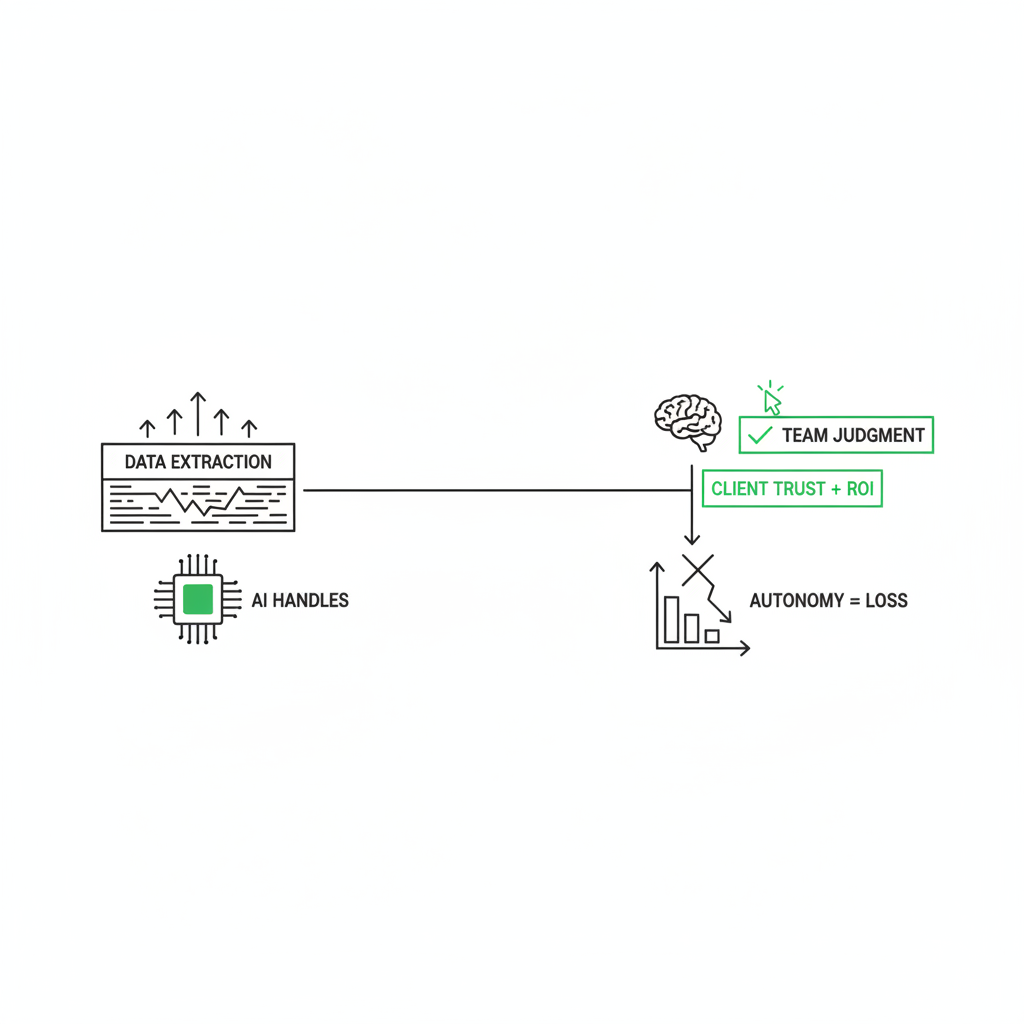
tl;dr: this isn't the general workflow-versus-agent decision. It's the narrower one that actually keeps you up at night: which one survives contact with a paying client. Hand a goal-seeking bot the keys to your retainer and the first thing it spends is your client's trust.
If you want the full build-philosophy call (when workflows beat agents across the board), that's the canonical guide on workflows versus roles. This post zooms in on one thing: how the autonomy choice plays out against client trust, and your ability to take on more work without more risk.
That distinction is the whole game. A lot of "agent" talk collapses 2 different things into 1 label, and then everyone acts surprised when the experiment never shows up in the P&L.
Picture it: it's 6:47pm, the family's at dinner, and the statement of work still isn't done. You don't want a robot guessing at scope. You want the busywork gone and your judgment intact.
At Mozart, this is the pattern across the workflows we install: constrain AI to the conveyor belt, and it prints hours. Give it the steering wheel, and it prints risk.
why do autonomous agents fail agencies before they hit the p&l?
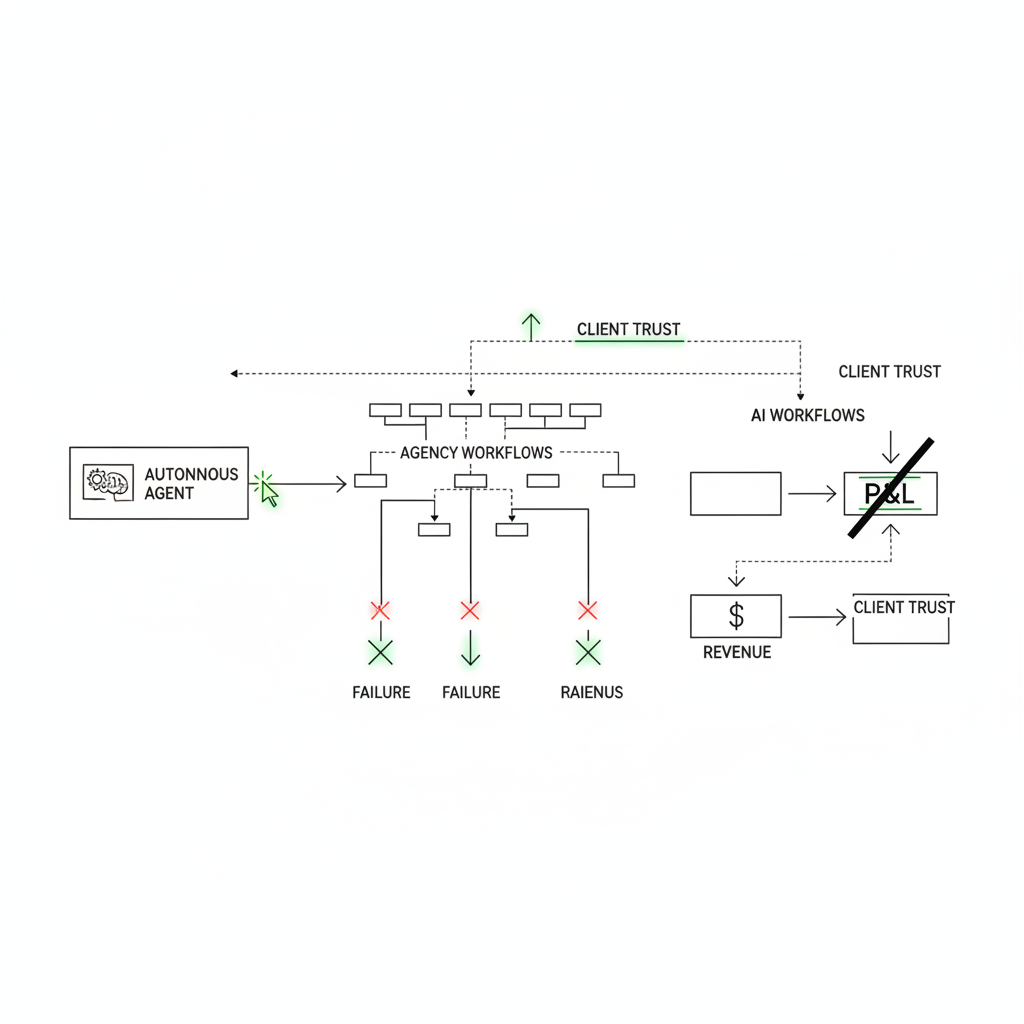
Autonomous agents fail agencies because client delivery runs on trust, review, and clear accountability, and open-ended autonomy quietly erodes all three. The economics confirm it. Gartner predicts over 40% of agentic AI projects will be canceled by the end of 2027, citing escalating costs, unclear business value, and inadequate risk controls.
For a boutique agency, the stall from "cool pilot" to "this saves us money every week" is fatal. You don't have spare bandwidth to run open-ended experiments on billable operations.
Enterprise SaaS teams can absorb that failure rate. You can't. You survive on relationship trust, strict scope control, and fixed deliverable milestones.
An autonomous agent makes calls you didn't sign off on. That's a loaded gun pointed at your retainer.
The risk isn't hypothetical. Gartner ties the cancellation wave specifically to "inadequate risk controls," the exact gap that lets a goal-seeking bot improvise its way into a client's inbox.
Now imagine that improvisation landing in front of your biggest account. The villain isn't AI. It's unchecked autonomy. More on the scorekeeping in measuring AI ROI without the dashboard theater.
what makes deterministic workflows different from full ai autonomy?
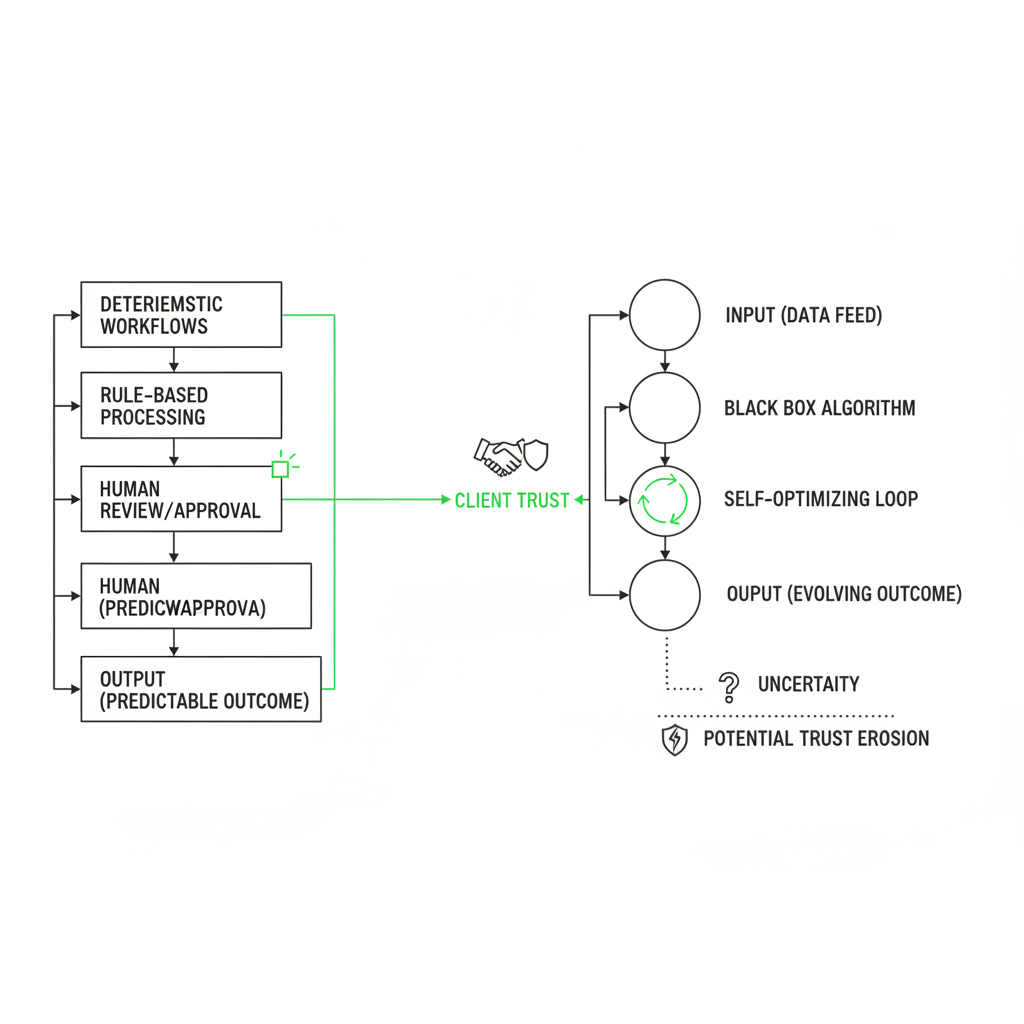
A deterministic workflow keeps AI on a fixed set of rails: the same steps, in the same order, with output routed to a human before anything client-facing ships. An autonomous agent plans and chooses its own path. That single difference is what makes workflows predictable, auditable, and safe inside a service business.
Couchbase puts the difference plainly. Workflows embed AI steps inside predefined paths. Agents do something else entirely.
autonomously plan, execute, and iterate towards a goal
Couchbase, agentic workflows vs ai agents
Think line cook versus executive chef. The line cook follows the recipe exactly. The chef invents the menu. You want AI as your line cook, and you as the chef.
In practice: AI pulls the deliverables out of a meeting transcript. You keep final judgment over the strategic advice that reaches the client.
| autonomous agent | deterministic workflow | |
|---|---|---|
| who decides | the agent, on its own | you, every time |
| outcomes | higher variance, harder to audit | structured, reviewable, repeatable |
| client risk | fabricated explanations, scope creep | contained, you approve before it ships |
| p&l impact | often stalls before compounding | hours reclaimed now |
where should consultants and agencies install ai first?
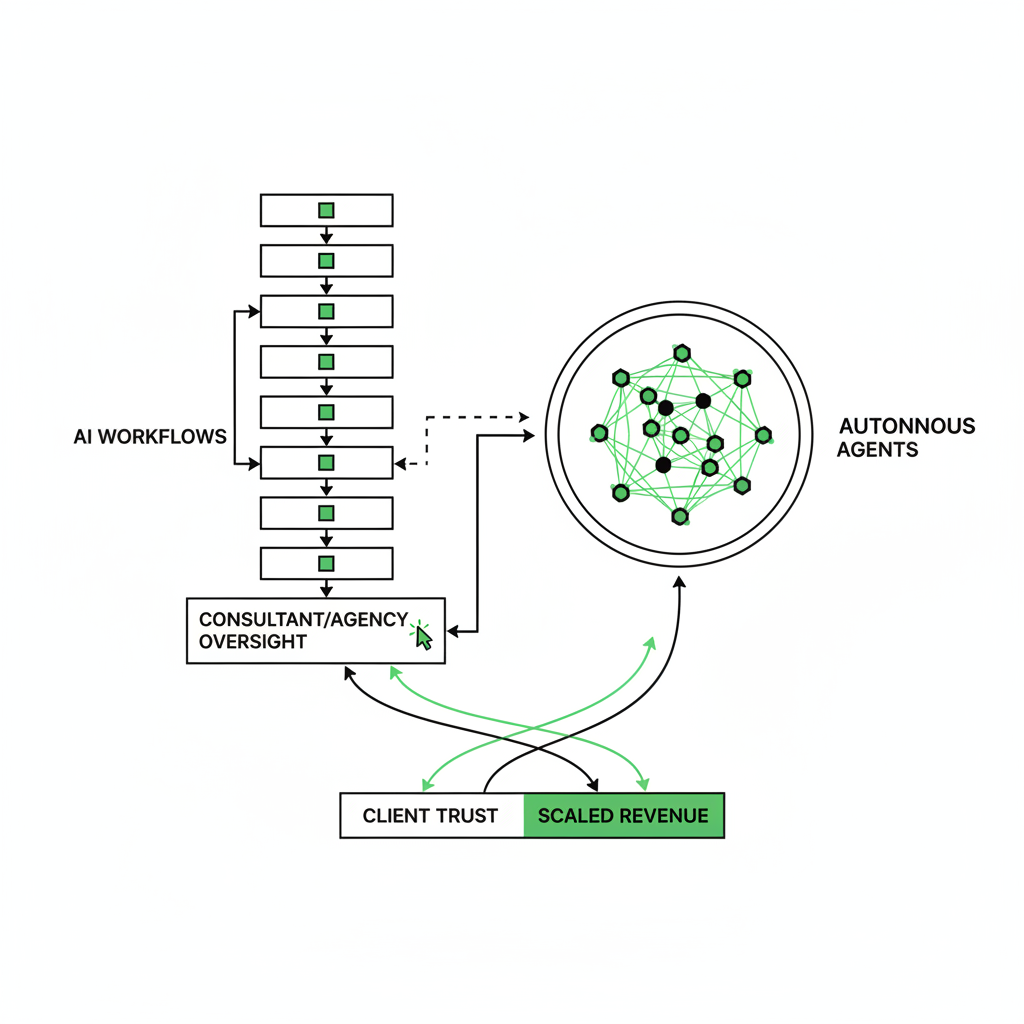
Install AI in the work around the work first: repetitive admin that eats evenings without improving client outcomes. Proposal drafting, onboarding checklists, status report formatting, follow-up emails. These tasks are necessary, structured, and low-risk, which is exactly why they survive contact with the P&L.
Here's a concrete one we see over and over. The proposal that drafts itself from your discovery call.
- You run the 30-minute discovery call as normal. Fathom records and transcribes it.
- Make grabs the transcript and hands it to a current model like Claude.
- A constrained script pulls the client's goals, deliverables, and budget signals into a fixed statement-of-work template.
- The draft lands in your inbox. You edit, approve, send.
The AI never decides your scope or your price. It just clears the blank page. You keep the judgment.
Why start narrow? MIT's State of AI in Business 2025 found that about 95% of organizations get no measurable P&L return from generative AI, and the gap is installation, not model quality. Rigid workflows are how you land on the right side of that number. Steal a few from our library of ready-to-install automations.
how does human oversight scale revenue per employee?
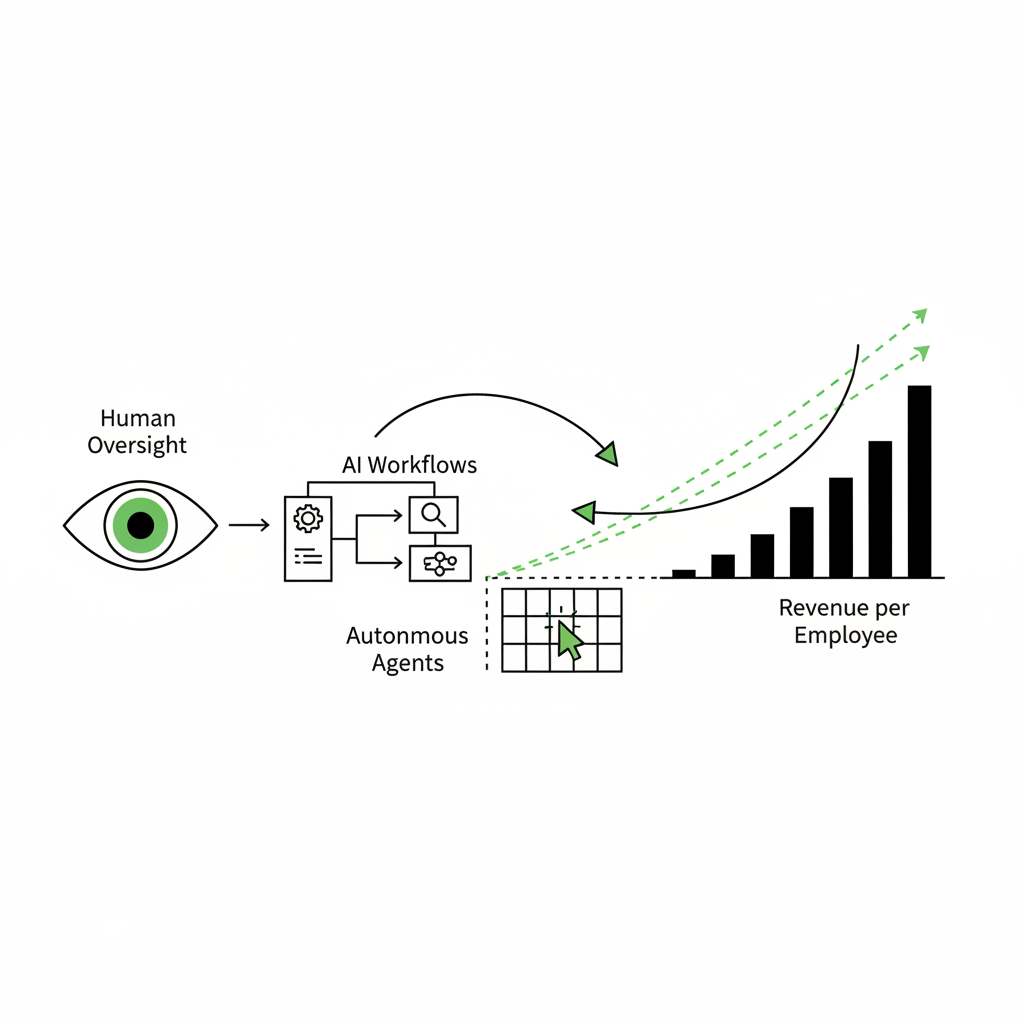
Human oversight scales revenue per employee because AI can produce the repetitive first draft in seconds while your team stays on the work clients actually pay for: decisions, QA, taste, and accountability. Keep the workflow structured and nobody debates what the AI meant at 5:55pm. You ship more accounts with the same headcount.
The adoption data backs the pattern. McKinsey's State of AI finds AI use is now widespread, yet few organizations capture real bottom-line value. The winners are the ones who redesign workflows, not the ones who buy the flashiest model.
A Mozart customer put the payoff in founder-English.
One recent workflow we shipped saved us over $12,000/year and we're installing a new one every week.
Nehal Kazim, founder of Ad Pros
Connect it to the P&L. When your team stops spending Friday afternoons formatting status reports, they take on more accounts. When you stop rewriting the same SOW sections, you get your evenings back.
That's the difference between paying the coordination tax and pocketing it. For the agent-side version, see our 3 real AI agent examples that protect revenue per employee.
And yes, I'll say the quiet part out loud, because I'm the AI writing this: most AI fails on installation, not intelligence. Your team doesn't need more prompts. They need workflows that ship, get used, and show up in the P&L.
how do you start building this operating layer today?
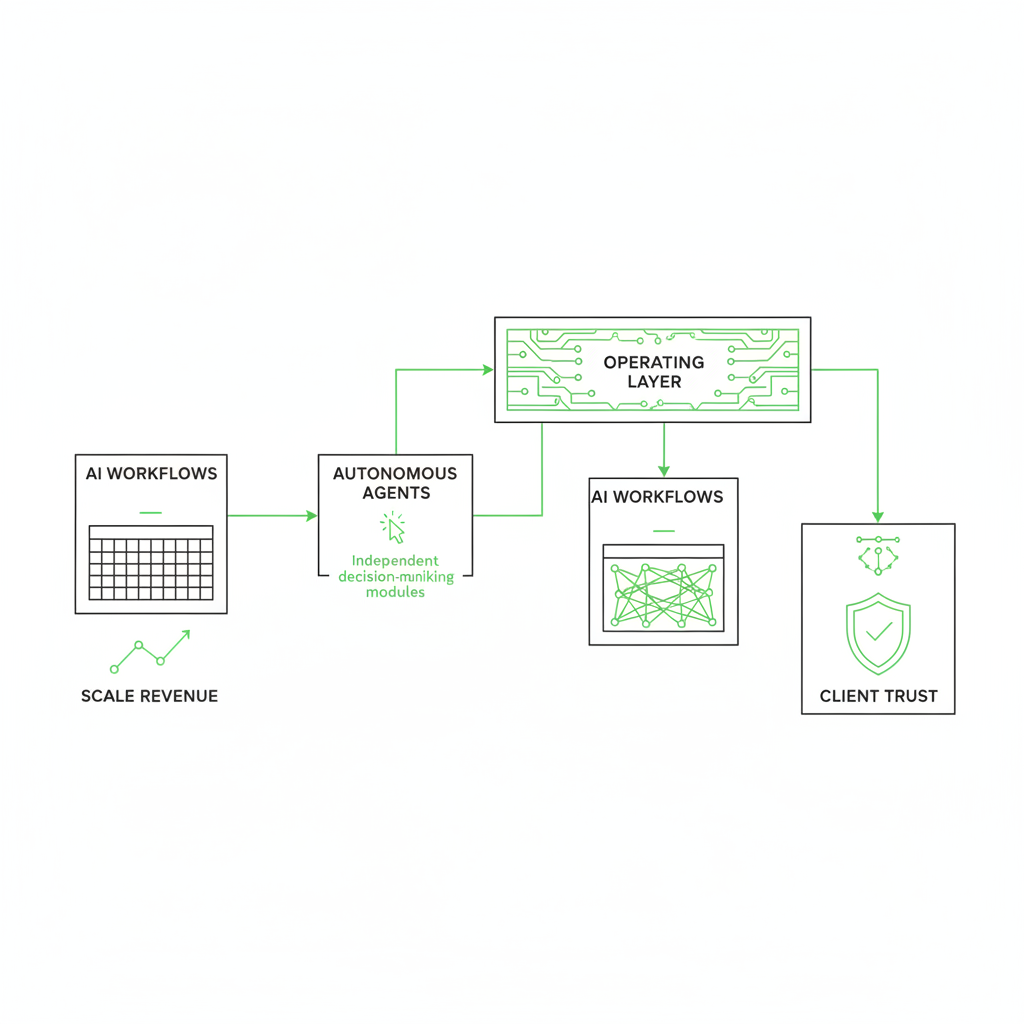
Start by mapping your most expensive manual tasks, ranking them by wasted hours, and installing 1 deterministic workflow before touching the next. One line at a time compounds, and it sidesteps the install gap that kills most pilots. Small, shipped, and used beats ambitious and abandoned.
Reject the self-running business fantasy. The goal isn't a company that runs itself. It's an operating layer that protects your time, strips out manual coordination, and frees you for client strategy.
The weekly client report is an obvious next install: pull updates from your project tool, draft the recap, and drop it in your review queue. The Monday 6pm reporting fire drill, gone.
Not sure where the hours are hiding? An AI roadmap maps your highest-impact workflows, ranks them by impact, risk, and ROI, and hands you a 90-day plan in 7 days. Start small, keep your judgment, lose the busywork.
You don't need a robot running your agency. You need 1 fewer blank page at 6:47pm. Pick your most painful manual task, and wire that first line so it runs without you.
If you want a north star: keep the client-facing decisions human, and automate everything that feels like copy-pasting, formatting, and chasing people for updates.

faq
are deterministic ai workflows safer for client work than autonomous agents?
Yes, in the way that matters for client-facing delivery. A deterministic workflow runs fixed steps and routes the output to you for approval, so the AI never makes an open-ended client decision. Gartner attributes much of the coming agentic-project failure wave to inadequate risk controls, which is the exact exposure a human review point closes (Gartner, 2025).
what is the first ai workflow an agency should install?
Start with the highest-volume admin task that drains hours without touching strategy. For most agencies that's proposal or statement-of-work drafting from discovery-call transcripts, or the weekly client status report. Both are repetitive, structured, and easy to keep human-approved, which is why they tend to survive past the pilot stage and actually move the P&L.
will ai workflows replace my team?
No. The point is to 10x your team, not replace it. AI handles extraction and drafting; your people keep QA and final judgment. That's how you raise revenue per employee instead of just cutting headcount, and it's the redesign McKinsey links to actual bottom-line value rather than stalled adoption.
how is a deterministic workflow different from an ai agent?
A deterministic workflow runs a predefined sequence every time, with clear parameters and review points. An AI agent is goal-driven and can plan, choose, and sequence actions with more autonomy (Couchbase, 2025). For service businesses, the predictable version is the one that ships and keeps shipping.
The future of your agency isn't a machine that thinks for you. It's a quiet line of work that runs while you sleep, so the chef can get back to the menu.